
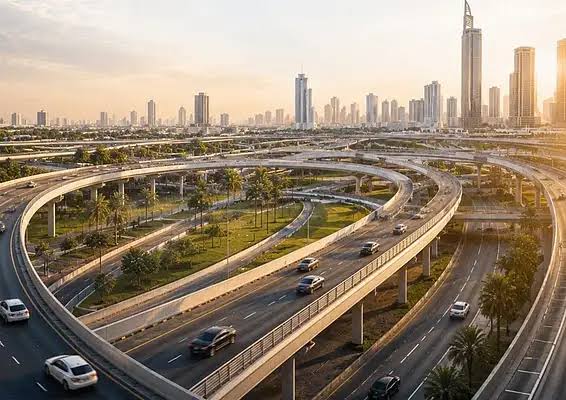
Dubai’s next phase of infrastructure development is not simply about adding more lanes to existing roads. The emirate is building a more interconnected road network designed to distribute traffic, improve cross-city movement and support the continued expansion of residential, commercial and mixed-use districts.
One of the most significant announcements in 2026 is the First Al Khail Street Development Plan — a strategic corridor designed to run parallel to Sheikh Zayed Road. The project forms part of a much broader programme of road investment across Dubai, connecting major corridors and improving access between established communities and emerging development zones.
For property investors, the important question is not simply whether a new road is being built. The more useful question is what better connectivity could change about the relationship between residential communities, employment centres, lifestyle destinations and transport corridors.
What Is the First Al Khail Street Development Plan?
The First Al Khail Street Development Plan is a major Dubai road infrastructure project announced by the Dubai Executive Council in July 2026.
The plan includes a 15-kilometre elevated carriageway with three lanes in each direction. Its strategic importance comes from its relationship with Dubai’s existing road network, particularly Sheikh Zayed Road and the wider Al Khail Road corridor.
Rather than viewing the project as an isolated road, it is more useful to see it as part of Dubai’s continuing effort to create alternative movement corridors across the city.
The key point for investors
- The project creates additional road capacity across a strategic part of Dubai.
- It is designed to provide another major movement corridor alongside Sheikh Zayed Road.
- It sits within a wider programme of road and corridor improvements.
- Better connectivity can change how investors evaluate accessibility between communities.
- Infrastructure should be considered alongside supply, pricing, rental demand and future development.
Where Does First Al Khail Street Fit Into Dubai’s Road Network?
Dubai’s road network has increasingly evolved from a small number of dominant highways into a more layered system of interconnected corridors.
Sheikh Zayed Road remains one of the city’s defining transport arteries. Al Khail Road provides another major north-south connection. Emirates Road and Sheikh Mohammed bin Zayed Road provide additional regional connectivity, while a growing network of bridges, tunnels and secondary corridors links residential and commercial districts into this wider system.
The First Al Khail Street plan should therefore be understood within this broader network rather than as a standalone infrastructure project.
This distinction matters for property investors. A road becomes economically meaningful when it changes the practical relationship between locations — reducing friction between where people live, work, shop and spend their leisure time.
What Is the Current Status of the Project?
The First Al Khail Street Development Plan was announced by the Dubai Executive Council on 1 July 2026. The announcement described the project as a strategic corridor parallel to Sheikh Zayed Road and confirmed the planned 15-kilometre elevated carriageway.
It is important to distinguish the officially announced scope from speculative timelines or figures circulating online. Infrastructure projects evolve through design, procurement, contracting and construction phases, and investors should rely on confirmed government announcements when assessing delivery.
For investment analysis, the announcement itself is already relevant because it provides visibility into the direction of Dubai’s future infrastructure planning.
What Could It Mean for Sheikh Zayed Road?
One of the strategic objectives behind creating additional corridors is to distribute traffic across a broader network.
Sheikh Zayed Road is one of Dubai’s most important transport corridors, connecting major residential, commercial, hospitality and business districts. Additional capacity elsewhere in the network can potentially give drivers more routing options and improve resilience when individual corridors experience congestion.
This does not mean that Sheikh Zayed Road suddenly becomes less important. Quite the opposite. Dubai’s approach is increasingly about creating multiple high-capacity connections rather than depending on a single route.
Why Roads Matter to Dubai Real Estate
Infrastructure and property markets are closely connected, but the relationship is more nuanced than simply saying that a new road automatically increases property prices.
Connectivity influences accessibility. Accessibility can influence how attractive a location is to residents, businesses and visitors. That demand can then affect rental markets, absorption rates and development decisions.
But infrastructure is only one variable.
Investors still need to consider purchase price, service charges, rental demand, supply pipeline, developer quality, community maturity, unit type and the specific position of a property within the wider area.
“A road does not create value by itself. The investment question is whether improved connectivity changes the economic relationship between a location and the rest of Dubai.”
Hassan Waqar
The Property Investment Framework
When I assess infrastructure announcements from an investment perspective, I prefer to separate the infrastructure story from the investment decision.
Areas Investors Should Watch
Several established and emerging areas sit within the broader network influenced by Dubai’s continuing road expansion. The relevance of each area is different, and investors should avoid treating all infrastructure-adjacent communities as identical.
Al Barsha
Al Barsha has an established residential base and strong access to major parts of Dubai. Its proximity to Sheikh Zayed Road, Al Khail Road and other strategic corridors makes connectivity an important part of the area’s long-term positioning.
Al Quoz
Al Quoz is undergoing a gradual transformation from a primarily industrial and commercial district into a more mixed economic environment. Improved road connectivity can become increasingly relevant as redevelopment and new commercial uses evolve.
Business Bay
Business Bay benefits from its central position and connection to Dubai’s wider road network. Its relationship with Downtown Dubai, Sheikh Zayed Road and Al Khail Road means transport accessibility remains an important part of the investment equation.
Meydan
Meydan is particularly relevant when looking at Dubai’s expanding central and southern residential districts. The wider network of Al Meydan Street, Latifa bint Hamdan Street and surrounding corridors is strengthening connectivity between a number of communities.
This Is Bigger Than One Road
The First Al Khail Street announcement becomes more interesting when viewed alongside several other major infrastructure projects announced during 2026.
Dubai is not simply building one new road. It is progressively creating a network of alternative corridors, bridges, tunnels and upgraded junctions that connect different parts of the emirate.
Three projects are particularly relevant when considering the broader infrastructure story.
The Latifa bint Hamdan Corridor
The Latifa bint Hamdan Corridor development is a major AED 2 billion project designed to improve connectivity across central and southern Dubai.
The corridor extends approximately 12 kilometres and connects Sheikh Zayed Road through Al Khail Road, Al Meydan Street, Sheikh Mohammed bin Zayed Road and Sheikh Zayed bin Hamdan Al Nahyan Street to Emirates Road.
The project includes seven bridges with a combined length of approximately 2.3 kilometres and eight tunnels totalling around 900 metres.
RTA estimates that the project will serve approximately 650,000 residents and visitors and accommodate around 16,000 vehicles per hour in both directions.
Once completed, the project is expected to reduce the journey between Umm Al Sheif Street and Emirates Road from approximately 33 minutes to 15 minutes. Completion is targeted for the end of 2028.
Al Meydan Street Development
Al Meydan Street is another important piece of the network.
The development connects the intersection with First Al Khail Street through Al Khail Road, Latifa bint Hamdan Street and Al Marabea’ Street, with further connectivity towards Sheikh Mohammed bin Zayed Road.
The wider programme also includes another section connecting First Al Khail Street through Al Khail Road towards Muscat Street, together with new surface roads linking Al Meydan and Latifa bint Hamdan Street.
Taken together, these projects illustrate why the First Al Khail Street announcement should not be analysed in isolation.
Dubai’s New Fourth Corridor
In September 2026, RTA also announced the New Fourth Corridor project, another major addition to Dubai’s regional road network.
The overall corridor is planned to extend approximately 80 kilometres from Al Faya Road in Abu Dhabi towards Al Shanouf Road in Sharjah.
The first phase covers approximately 30 kilometres between Al Shanouf Road and Dubai–Al Ain Road, with an announced investment of AED 3.5 billion.
The project includes major bridges and tunnels and is designed to improve inter-emirate connectivity, support logistics and strengthen access to important economic areas including Al Maktoum International Airport and Etihad Rail.
This is a different scale of project from First Al Khail Street, but it reinforces the same underlying trend: Dubai is building infrastructure for a city that expects continued population, business and logistics growth.
The wider infrastructure picture
- First Al Khail Street: a strategic elevated corridor parallel to Sheikh Zayed Road.
- Latifa bint Hamdan Corridor: a major east-west connection linking several important roads.
- Al Meydan Street: improved connectivity through Meydan and surrounding districts.
- New Fourth Corridor: a major inter-emirate route supporting logistics and regional connectivity.
Will Property Prices Automatically Rise?
No infrastructure announcement should be treated as a guaranteed property price catalyst.
Property values respond to multiple factors simultaneously. If an area receives better connectivity but also experiences a large increase in competing supply, the outcome may be very different from an established community where demand is already strong and additional infrastructure removes a genuine accessibility constraint.
The same applies to individual buildings. A property that is technically close to a new road may not benefit in the same way as one with practical access to the new network.
Investors therefore need to move from the headline — “new road” — to the underlying question: what changes for this specific property?
Should Investors Buy Before the Road Is Completed?
There is no universal answer.
Buying before infrastructure completion can provide exposure to future improvements, but it can also mean accepting construction uncertainty, longer holding periods and the possibility that the expected benefit has already been priced into the market.
The appropriate approach is to evaluate the property independently first and then determine whether the infrastructure provides additional support to the investment case.
In other words, I would not buy a property simply because a new road is coming. I would want the property to make sense on its own, with the infrastructure acting as one additional factor rather than the entire thesis.
My Perspective
Dubai’s infrastructure strategy is becoming increasingly important for property investors because the city is expanding faster than its traditional transport patterns.
New residential communities are appearing further from the historic city centre. Commercial districts are evolving. Logistics and airport infrastructure are expanding. Population growth is creating new movement patterns.
The road network has to evolve with that growth.
The First Al Khail Street Development Plan is therefore significant not simply because it adds another road, but because it demonstrates how Dubai is planning for a more distributed, interconnected city.
For investors, that creates an important analytical opportunity: understanding which locations become better connected before that connectivity becomes fully reflected in property pricing.
But infrastructure should always be analysed alongside fundamentals. Connectivity is valuable. It is not a substitute for sensible pricing, genuine demand and a strong underlying investment case.
The Investment Takeaway
The First Al Khail Street project should be viewed as one component of a much larger transformation of Dubai’s road network.
The combination of First Al Khail Street, Latifa bint Hamdan Corridor, Al Meydan Street and the New Fourth Corridor points towards a city designed around multiple interconnected transport routes rather than dependence on a small number of dominant highways.
That matters for property because accessibility influences how people experience a location.
The opportunity for investors is not to speculate blindly on which neighbourhood will rise next. It is to understand where infrastructure, population growth, employment, development and existing demand intersect — and then assess whether current pricing adequately reflects that future.
Dubai Infrastructure & Property Investment Summary
| Project / Area | Why It Matters | Investor Lens |
|---|---|---|
| First Al Khail Street | Strategic elevated corridor parallel to Sheikh Zayed Road. | Watch connectivity and accessibility across nearby districts. |
| Latifa bint Hamdan Corridor | Major connection linking Sheikh Zayed Road, Al Khail Road, Al Meydan Street and Emirates Road. | Relevant to central and southern Dubai communities. |
| Al Meydan Street | Strengthens connectivity through Meydan and surrounding corridors. | Relevant to Meydan and nearby residential development. |
| New Fourth Corridor | Major inter-emirate route supporting logistics and regional connectivity. | Relevant to long-term regional growth and logistics access. |
| Al Barsha / Al Quoz / Business Bay | Established areas connected to Dubai’s wider strategic road network. | Assess existing demand, pricing and future competing supply. |
| Meydan | Increasingly connected through Al Meydan Street and surrounding infrastructure. | Watch the interaction between new infrastructure and continued development. |
FAQs: Dubai’s First Al Khail Street Project
What is the First Al Khail Street Development Plan?
It is a strategic Dubai road infrastructure project announced in July 2026 that includes a 15-kilometre elevated carriageway with three lanes in each direction, designed to run parallel to Sheikh Zayed Road.
How long is the First Al Khail Street elevated carriageway?
The officially announced plan includes approximately 15 kilometres of elevated carriageway.
Why is the project important for Dubai?
The project forms part of Dubai’s wider effort to increase road capacity, create alternative routes and improve connectivity between major parts of the emirate.
Will First Al Khail Street increase property prices?
Improved infrastructure can support accessibility and demand, but there is no automatic relationship between a road project and property price growth. Supply, pricing, rental demand, location and wider market conditions also need to be considered.
Which areas could benefit from Dubai’s wider road expansion?
The impact will vary by project and location. Areas including Al Barsha, Al Quoz, Business Bay, Meydan and communities connected through the Latifa bint Hamdan and Al Meydan corridors are relevant areas to monitor.
When will the wider Dubai road projects be completed?
Different projects have different delivery programmes. For example, RTA has stated that the Latifa bint Hamdan Corridor is targeted for completion by the end of 2028. Investors should rely on official RTA and Dubai government announcements for project-specific timelines.
Should I buy property because of a new road project?
Infrastructure should be treated as one part of an investment analysis rather than the sole reason to purchase. The property itself should make sense based on price, demand, supply, location, developer quality, rental potential and the intended holding period.
Want to understand what Dubai’s infrastructure expansion means for property?
If you are assessing Dubai property from an investment, relocation or long-term wealth perspective, I can help you evaluate the relationship between infrastructure, location, demand and pricing.
Dubai Media Office — First Al Khail Street Development Plan, July 2026
Official Dubai Media Office announcement
RTA — Latifa bint Hamdan Corridor Development Project
Official RTA project announcement
Dubai Media Office / RTA — Al Meydan Street Development
Official Dubai Media Office announcement
RTA — New Fourth Corridor Project